
Disassembling and testing TGS-7A (always wanted to do it)
9 min
Circuit design
*
Gadgets
DIY or DIY
Health

Today we will distract ourselves from programming microcontrollers, allow ourselves to relax a little and talk about another interesting topic — medicine (why not?).
There is one interesting device in my household that I have been successfully using for both medical and research purposes for a long time — it is widely known in narrow circles, one can even say the cult TGS-7A for Mishins Coil.
As you can guess, I am not the person who will “obediently” press the buttons on the front panel and blow the dust off the “expensive” gadget — I have been itching to disassemble it for a long time and figure out how it works and how it will work.
Next, I offer you a report on my research on this extremely interesting topic.
What is TGS-7A?
TGS-7A is a sinusoidal signal generator and part of a kit for “electrostatic” physiotherapy. The second part of the kit is a variety of coils, each of which has a certain geometry and is used for certain diseases (a certain group of diseases).
There are many similar generators, both amateur and manufactured by manufacturing companies. In addition to the TGS-7A in my collection there are Live Sinus 6, Atten ATF20B (general purpose DDS generator) and others. All these generators have their own features and nuances of application, I started analyzing their device with the TGS-7A because it is one of the most popular generators of this kind and I was curious to understand its device in the first place.
Note. In this article I will not touch on the medical aspect of technology and will focus only on the technical. Medical topics will be touched upon only in passing and only to the extent necessary to understand the essence of the technical issues under consideration.
But a few words about the medical aspect still need to be said. The technology in its current incarnation has existed for almost 10 years and during this time a huge number of reviews of people who have been cured of almost all diseases with its help have accumulated on the Internet. How to treat this — I leave it up to the readers, but, in my opinion, it is simply unreasonable to ignore such a large number of independent and unbiased testimonies.
I chose the easiest way for myself — I bought equipment and conducted experiments on myself in the spirit of Mechnikov. And I received positive (sometimes even phenomenal) results in the treatment of various diseases. In general, for myself the question “does it work or not?” I decided and the usefulness of such devices I have no doubts.
In general, the analysis of medical methods of using this technology and their nuances is a topic for a separate article and most likely not one, perhaps we will talk about this another time, but now we will focus on technical issues.
Technical aspect
From a technical point of view, everything is quite simple: the kit consists of a generator and a coil connected to it. The generator is a conventional generator of a sinusoidal signal, and the coil is a so—called “Tesla bifilar coil”, where two (open) wires are connected in one plane, and they are connected to the generator from different ends. Since the wires are open, we get a kind of capacitor, the plates of which are formed by twisted wires.
In general, this is all, the rest is the nuances and options for implementing this basic scheme. However, it should be noted that these nuances are quite subtle and not obvious, and without a good understanding of the theory, it is unlikely that it will work out to do something meaningful in this direction.
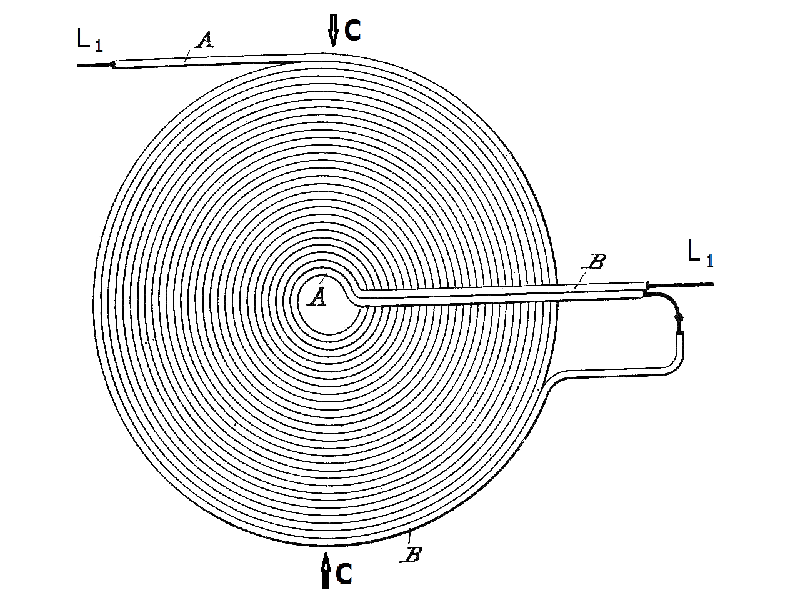
Tesla bifilar coil (Nikola Tesla patent US 512340, 1894), now better known under the pseudonym “Mishin coil” (KM).
Such a coil has interesting physical properties and can be used for various purposes. In our case, its property is used to create an alternating electrostatic field when powered by a sinusoidal signal generator (the optimal frequency of exposure, found experimentally, is about 300 kHz).
As a result of the operation of such a coil, a complex volumetric field is formed, where the electrostatic (useful in our case) component is the main one, and the electromagnetic component is a side or “parasitic” one. The electrostatic component of the field changes 300 thousand times per second, which ensures the therapeutic effect of such a complex on the human body (as well as animals and plants).
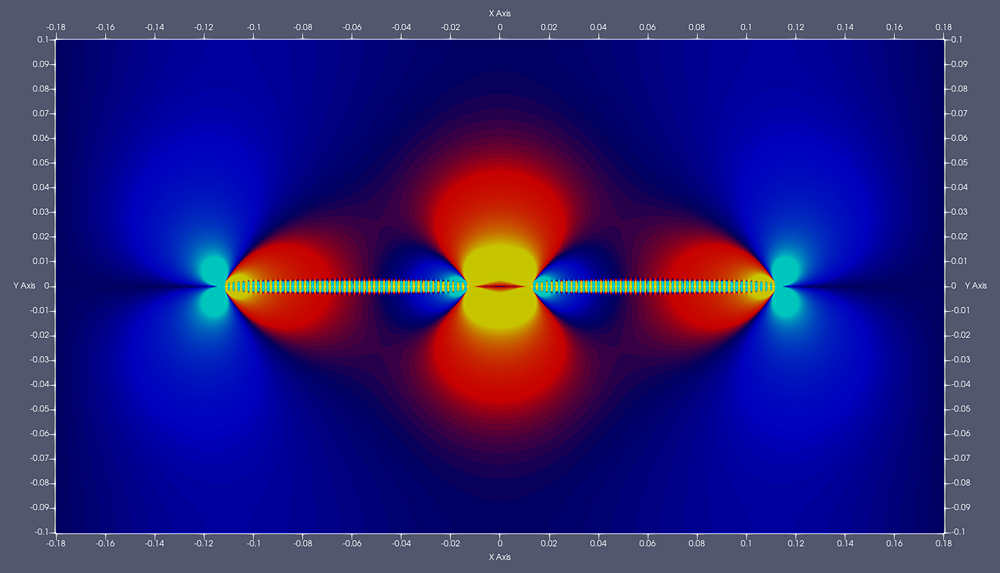
The result of modeling the fields formed during the operation of the KM, a view in the plane of the coil (the picture is not mine, taken from the Internet as a visual illustration).
I have some doubts about the accuracy of modeling real physical processes in this illustration, but this picture can be used for a general understanding of the geometry of fields arising during the operation of the coil. The size and location of the regions depends on the geometry of the coil (its linear dimensions and the ratio of internal and external diameters), the composition and thickness of the wire, the insulation material and its dielectric constant, the inter-turn distance, etc.
Since the coil is open, the maximum current consumption (the maximum of the generated electrostatic field) falls on its resonant frequency, which should be around 300 kHz, and the generator should be able to either auto-tune the frequency or change it manually.
There are no special requirements for the generator — it must generate a sinusoidal signal with an amplitude of up to 20 volts and provide current in the coil up to 100-300 mA (as well as the correct waveform when working with various types of coils).
That’s all with the theory (so far), we turn to practical actions on the analysis of TGS-7A.
We disassemble the TGS-7A
In general, according to the accompanying theory, you can write more than one course of lectures, but in this article we will limit ourselves only to analyzing the TGS-7A generator and getting acquainted with its electronic stuffing. Let’s start with turning over the patient and examining his fasteners (which are hidden under the decorative film). The manufacturer carefully marked the locations of the fastening screws with the corresponding pictograms.

The film, apparently, also serves as a “seal”, protecting the device from interference by overly curious “pioneers” like us. (But when did our pioneers stop the seals?).
We take a scalpel and perform the operation “exposing Isis”, cut out the excess, and we get the same generator, but only with fastening screws open for access. The size of the hats inspires respect — you can hang, for example, a kitchen cabinet on such screws.

Unscrew the screws and remove the bottom cover of the housing (pallet). In general, the design of both the TGS-7A generator itself and its parts makes unhealthy associations with plastic basins, but this is not important in this case, the main thing for us is the filling and its action to create the sinusoidal signal we need (and the corresponding fields).

And finally, the filling itself is TGS-7A. Everything is done carefully, it is clear that the case is universal and has a lot of free space to accommodate the boards of new revisions and the filling of future models of similar devices.
The photo shows exactly the upper (not the lower) part of the case with a board attached to it and a massive transformer. Now it becomes clear the subconscious cognitive dissonance when you pick up the TGS-7A — it is not balanced and its center of gravity is at the top, not at the bottom. But again, these are only nuances that do not affect the basic functionality of the generator.

The power cord is made non-removable, which in this case I would not consider a disadvantage. 6 sufficiently powerful screws are also not superfluous — the transformer has a significant weight and the board with it needs to be securely fixed.
As for the plastic ties, I do not even know what to say: on the one hand, they will not be superfluous, and on the other, they may eventually crack and stop fixing the transformer.
Circuit design
I have not found the schemes of the TGS-7A in the public domain, but it will be quite enough for us to get a general idea of its circuitry and principles of operation according to the stuffing available for research. Let’s start by unscrewing the screws and removing the generator board from the housing.

The reverse side of the board with control buttons and indicator LEDs. Plastic braces and a piezoelectric squeaker on the side complement the picture picturesquely.

View of the TGS-7A board from above. The appearance of some connections suggests manual soldering of SMD components (which is somewhat strange). Of the advantages, we can note the complete absence of traces of flux — I have not come across such clean boards for a long time.

The underside of the TGS-7A board. The zonal division of the functional parts of the generator is visible to the naked eye: the power region, the control region and the region of the generator elements themselves.

Power supply unit
The transformer TransLed TP-152-5 with a secondary winding voltage of 12 V AC is used in the power subsystem. The voltage on the filter capacitors (after the rectifier diodes) fluctuates around 13 V DC, depending on the operating mode of the generator (current load).
In the photo, attention is drawn to the absence of a fuse — in its place there is a track on the printed circuit board, which indicates that it was not particularly intended to be installed, you can install it only by cutting this track.

Photo of the TP-152-5 transformer itself and its markings.

Control buttons and indicators
The control region contains buttons and LEDs indicating the current operating modes of the generator. All this household is connected to a microcontroller, which is engaged in their maintenance.

With the buttons, too, everything is simple: the bottom row sets the timer running time of 5, 15, 30, 60 minutes, and the three vertical buttons are responsible for (programmatically) turning on/off the generator, power, and the so-called “rotation of the field”, which I will tell you about a little below.
There is also a “no field” indicator, the name of which speaks for itself.

Photo of the front panel with all control elements.
ATmega8A Microcontroller
The ATmega8A microcontroller acts as the controller, which is engaged in the maintenance of buttons and LEDs, and also provides all the logic of the generator (switching modes, counting time intervals, etc.).
The TRR-1A-05F-00D relay is involved in switching the operating modes (in the photo there is a dark quadrilateral next to the microcontroller).

Next to the ATmega8A, a 6-pin connector is visible, which hints at the possibility of pouring new firmware or self-programming the microcontroller.
Generator

The TGS-7A is built on the HEF4046BT chip of a phase—locked frequency generator (PLL), the second chip next to it is the HEF4069UBT, containing 6 inverters (logic elements NOT) and performing auxiliary functions. In our case, the frequency phase adjustment range is limited to 250-400 kHz, which is honestly written on the front panel of the device.
The HEF4046B is a phase-locked loop circuit that consists of a linear voltage controlled oscillator (VCO) and two different phase comparators with a common signal input amplifier and a common comparator input. A 7V regulator (zener) diode is provided for supply voltage regulation if necessary.
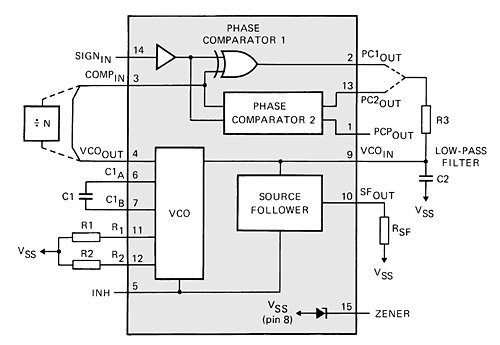
Functional diagram of the HEF4046BT generator.
The amplification of the generated sinusoidal signal is carried out by two complementary PNP/NPN transistors BCP53-16/BCP56-16 (80 V, 1 A) with the appropriate binding. The dimensions of the areas surrounding the transistors on the printed circuit board indicate the possibility of using other types of transistors and the possibility of installing radiators for them.
The general functional scheme of the TGS-7A generator can be represented as follows:

Here, the amplifier unit and the connected coil represent a single oscillatory system, information about the state of which is transmitted via a feedback circuit to the HEF4046BT chip of the generator with phase-locked frequency.
The ATmega8A microcontroller can control the operating modes of the system and, among other things, set the so-called “field rotation” mode, when the HEF4046BT generator forcibly cyclically changes the phase of the generated signal (thereby physically rotating the generated field in space).
In general, everything is clear with the principle of operation of the TGS-7A generator, now we turn to full-scale tests and experiments.
Testing the operation of TGS-7A
We will test the operation of the TGS-7A generator on a standard 15-centimeter coil that comes with it, the so-called “coil No. 1”. In principle, testing can be carried out on any other similar coil, but it is interesting to see how the TGS-7A works with the “native” peripherals.

Testing will consist in determining the intrinsic resonant frequency of the coil and the parameters of the signals generated by the TGS-7A when working on it (current and voltage amplitudes, as well as the waveform). As a reference sample, we will take work with the same DDS coil of the Atten ATF20B generator. We will control all processes using an oscilloscope.
The ATF20B provides the generation of signals of various shapes with a frequency of up to 20 MHz and an amplitude of up to 20 volts (which is just right for our tests). The beauty of the ATF20B is that we can set the frequency of the generated signals with an accuracy of 1 Hz.
The voltage amplitude will be measured directly, and the current amplitude using a resistor with a resistance of 1 ohm.

Hardware complex of a novice vortex therapist
As a result of measurements on the stand with the Atten ATF20B generator , it turned out: the natural resonant frequency of the coil is 302.85 kHz, the voltage at the resonant frequency is 2.93 V and the current in the coil is 270 mA. The phases of current and voltage exactly match, (which is not surprising) since the resonant frequency was set manually on the DDS generator.
The coil successfully “squandered” the input 20 V of the generator to 2.93 V at resonance, quite effectively converting (pumping) energy into (the field we need).

Operation of the “coil No. 1” paired with the Atten ATF20B generator
Now we connect the coil to the TGS-7A generator and see what the HEF4046BT and a pair of transistors have done there in automatic mode. Oddly enough, the result is almost identical to manual tuning on a DDS generator: frequency 303.53 kHz, voltage 3.11 V and current in the coil 230 mA.
The TGS-7A generator also has a slight lag of the current phase from the voltage, but in this case it is not critical — the complex is intended for medical purposes, and in this context, another big question is whether a small mismatch of current and voltage in the coil is good or bad (there is an opinion that it is just good).

Operation of the “coil No. 1” in conjunction with the generator TGS-7A (default mode)
Well, the shape of the sinusoidal signal is almost perfect, without any visible distortion. In general, we can say that the TGS-7A performed just fine in this test (at the level of manual Atten ATF20B configuration).
Conclusion
As they say, “oh, how many wonderful discoveries we have…” Today we learned how the TGS-7A generator works and will work, but this topic is truly inexhaustible and there are many interesting discoveries ahead of us.
By the way, I’m also interested in how the “coil No. 1” is arranged inside. And you?
RU: Вообще то, про лечебное воздействие катушки изобретателя Александра Николаевича Мишина могу сказать следующее. Область воздействия на тело располагается от поверхности на глубину 10-15 см мягкой ткани, не перекрытую костной тканью. Небольшие кости практически не влияют на распространение области воздействия. Для тучных людей на первых порах малоэффективно. Лечебные эффекты такие: 1. Однозначный быстрый обезболивающий эффект через 5-10 минут применения на область боли. 2. Антивоспалительный эффект. Внутренние воспаления проходят за 1-3 раза применения по инструкции. (Кстати, впервые это заметил сам А. Мишин, случайно. После чего начал применять и исследовать лечебные свойства катушки целенаправленно.) 3. Выраженный успокоительный эффект на всей нервной системе после применения по инструкции. 4. Остальные замеченные оздоровительные эффекты – не 100%, зависят от … (пока неизвестно науке). 5. Единственный отрицательный эффект – передозировка, усугубляемая недостатком воды в организме. 6. Не совсем точно сказал по поводу 5-го пункта. Единственный отрицательный эффект, который может быть – это интоксикация области воздействия в теле, токсинами в высокой концентрации. Токсины в повышенной дозе возникают в области воздействия катушки. В норме они должны как то естественным путём изгоняться из организма с помощью циркулирующей жидкости. Поэтому инструкцию по применению крайне рекомендуется соблюдать. 7. Кстати, из-за циркуляции крови по всему организму, оздоровительный эффект возникает и в других частях тела. Кровь (или лимфа), проходя через область воздействия катушки, оздоравливается, и несёт “здоровье” дальше по телу. 8. В целом, что могу сказать по теме лечения катушками А. Мишина – повторить конструкцию не сложно. Сложно понять, почему она оздоравливает. Потому что на самом деле она ничего не лечит. Она лишь создаёт эффекты на молекулярном уровне, изменяя физико-химические свойства попавших в область воздействия молекул. И ещё мне кажется, что настоящее лечение начинается после выключения катушки, особенно сильно в первые часы. 9. Собственный опыт регулярного использования различных видов катушки Мишина на себе, семье и десятке друзей и знакомых в течение 6 лет. Простудные заболевания исчезли как класс – при первых признаках ставим катушку на центр иммунитета (на живот на 5 см ниже пупка), и болезнь не возникает. Иногда нужно применить тор (немного другая конструкция катушки Мишина) на носоглотку или горло. 10. Могу подтвердить эффективность при простудных заболеваниях и как обезболивающее при суставных болях, а также просто феноменальную результативность по лечению кожных болезней.
Кроме того, стоит отметить, что катушки Мишина не являются заменой для традиционной медицины и не должны использоваться в качестве единственного способа лечения серьезных заболеваний. Они могут служить дополнением к основному лечению или использоваться для профилактики и поддержания здоровья.
В целом, катушки Мишина – это интересное и необычное явление, которое требует дополнительных исследований и тщательного изучения. Если вы заинтересованы в использовании катушек Мишина для лечения или профилактики заболеваний, обязательно проконсультируйтесь с квалифицированным врачом и следуйте инструкциям по применению.
EN: Regarding the healing effects of Alexander Mishin’s coil, I can say the following. The area of effect on the body extends from the surface to a depth of 10-15 cm of soft tissue not covered by bone tissue. It is not very effective for overweight people. The healing effects are as follows:
- It provides a clear and fast pain relief effect within 5-10 minutes of applying it to the painful area.
- It has an anti-inflammatory effect. Internal inflammations disappear after 1-3 applications according to the instructions. (By the way, Alexander Mishin first noticed this by accident, after which he began to use and study the healing properties of the coil purposefully.)
- It has a pronounced calming effect on the entire nervous system after applying it according to the instructions.
- Other observed healing effects are not always 100% effective and depend on unknown factors.
- The only negative effect is overdose, which is exacerbated by a lack of water in the body.
- It is not entirely clear what is meant by the 5th point. The only negative effect that can occur is the intoxication of the affected area with high concentrations of toxins. Toxins in high doses appear in the area affected by the coil. In normal conditions, they should be naturally expelled from the body with the help of circulating fluids. Therefore, it is important to follow the instructions for use.
- By the way, due to the circulation of blood throughout the body, the healing effect also occurs in other parts of the body. Blood (or lymph) passing through the area affected by the coil becomes healthier and carries “health” further into the body.
- Overall, I can say that it is not difficult to replicate the design of Mishin’s coil. However, it is difficult to understand why it has healing properties. This is because it does not actually treat anything. It only creates effects at the molecular level, altering the physicochemical properties of the molecules that enter the affected area. Additionally, it seems to me that actual healing begins after the coil is turned off, especially in the first few hours.
- This is based on my own experience of regularly using different types of Mishin’s coil on myself, my family, and dozens of friends and acquaintances for 6 years. Cold-related illnesses disappeared entirely – at the first signs, we place the coil on the center of immunity (on the abdomen 5 cm below the navel), and the disease does not occur. Sometimes, it is necessary to use the “tor” (a slightly different construction of Mishin’s coil) on the nasal cavity or throat.
- I can confirm its effectiveness for cold-related illnesses and as a pain reliever for joint pains, as well as its phenomenal effectiveness in treating skin diseases.
- The “Mishin Coil” electronic device is designed to treat various human illnesses and has been tested according to recommendations from Mishin himself and other manufacturers. The device’s generator automatically finds the resonant frequency of the coil, which strengthens the body’s immune system and aids in the healing process. The device has a wide range of applications, including oncology, blood diseases such as leukemia, skin conditions, joint disorders, parasite elimination (ticks, worms, lice, ascarids, etc.), inflammatory diseases (prostatitis, dermatitis, lichen, gastritis, colitis, conjunctivitis, meningitis, nephritis, furuncle, rhinitis, etc.), type I and II diabetes, kidney stones, pyelonephritis, gallstones, cholecystitis, allergies, varicose veins, finger darkening, skin diseases such as vitiligo, jaundice, stomach and duodenal ulcers, thyroid diseases, nodules on the thyroid, teeth, gums, periodontitis, heart arrhythmia, drug addiction, psoriasis, hernias, vertebral disc protrusions, panic attacks, ankylosing spondylitis, lymphedema, allergic asthma, past ischemic stroke, pancreatic cysts, cataracts, macular degeneration, Parkinson’s disease, multiple sclerosis, epilepsy, Tourette syndrome, scleroderma, venous sinus thrombosis of the brain, and trigeminal neuralgia, among others. The device is suitable for use at any age and has also shown positive effects on animals and plants. In addition, it improves the quality of water by reducing its acidity (lowering pH).
It is important to note that Mishin coils are not a substitute for traditional medicine and should not be used as the sole means of treating serious illnesses. They can be used as a complement to mainstream treatments or for preventive health maintenance.
Overall, Mishin coils are an interesting and unusual phenomenon that requires further research and thorough study. If you are interested in using Mishin coils for treatment or prevention of illnesses, be sure to consult a qualified physician and follow the instructions for use.


